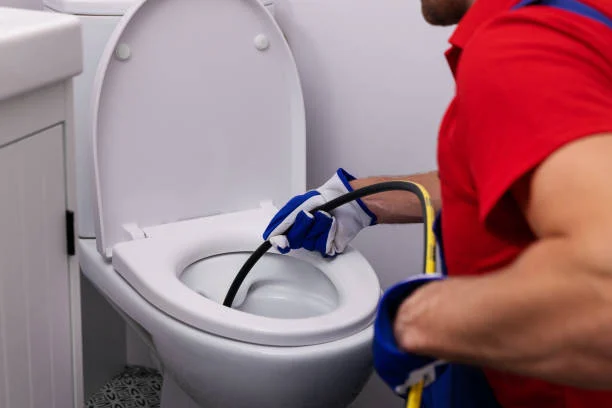
Whether you are in your own home or a friend’s house, you may eventually find yourself with a clogged toilet and no plunger anywhere in the building. That is an awkward situation, and it gets worse fast if you handle it the wrong way. The good news is that most toilet clogs are soft, made of paper and waste, and soft clogs give way to things you already own.
Here are seven methods, in the order we would try them, with what each one clears and what each one can wreck if you push it.
If you would rather not do any of this, our toilet repair team handles clogs across Lakeland, Plant City, Winter Haven, and the surrounding area.
Before anything else, stop the water
If the bowl is rising toward the rim, do not flush again. Another flush is what turns a clog into a floor full of wastewater.
Reach behind the toilet and turn the small oval or football-shaped valve clockwise until it stops. That shuts off the supply and the bowl stops filling. If the valve is stuck or painted over, lift the tank lid and push the flapper down by hand to close it.
Then get the water level down. A bowl filled to the brim leaves you no room to add anything, and every method below needs room. Bail a few cups out with a disposable container and put down towels. What to do if your toilet overflows covers the mess side of this in more detail, and when the bowl fills up instead of emptying explains why it happens at all.
Method 1: Flush once, properly
Some clogs are not clogs. If you did not hold the handle all the way down, the flapper closed early and the tank only sent part of its water. The bowl looks high because the flush was weak, not because anything is stuck.
Hold the handle down fully and let the whole tank empty. Do this once. If the level rises instead of dropping, stop, and go back to shutting the valve.
If weak flushes are a pattern rather than a one-off, the flapper or fill valve is worn out and the toilet is going to keep doing this. That same worn part is usually why a toilet makes noises between flushes.
Method 2: Dish soap and hot water
Soap and hot water is the method to reach for on a soft clog, and it is the one the household tips usually leave out.
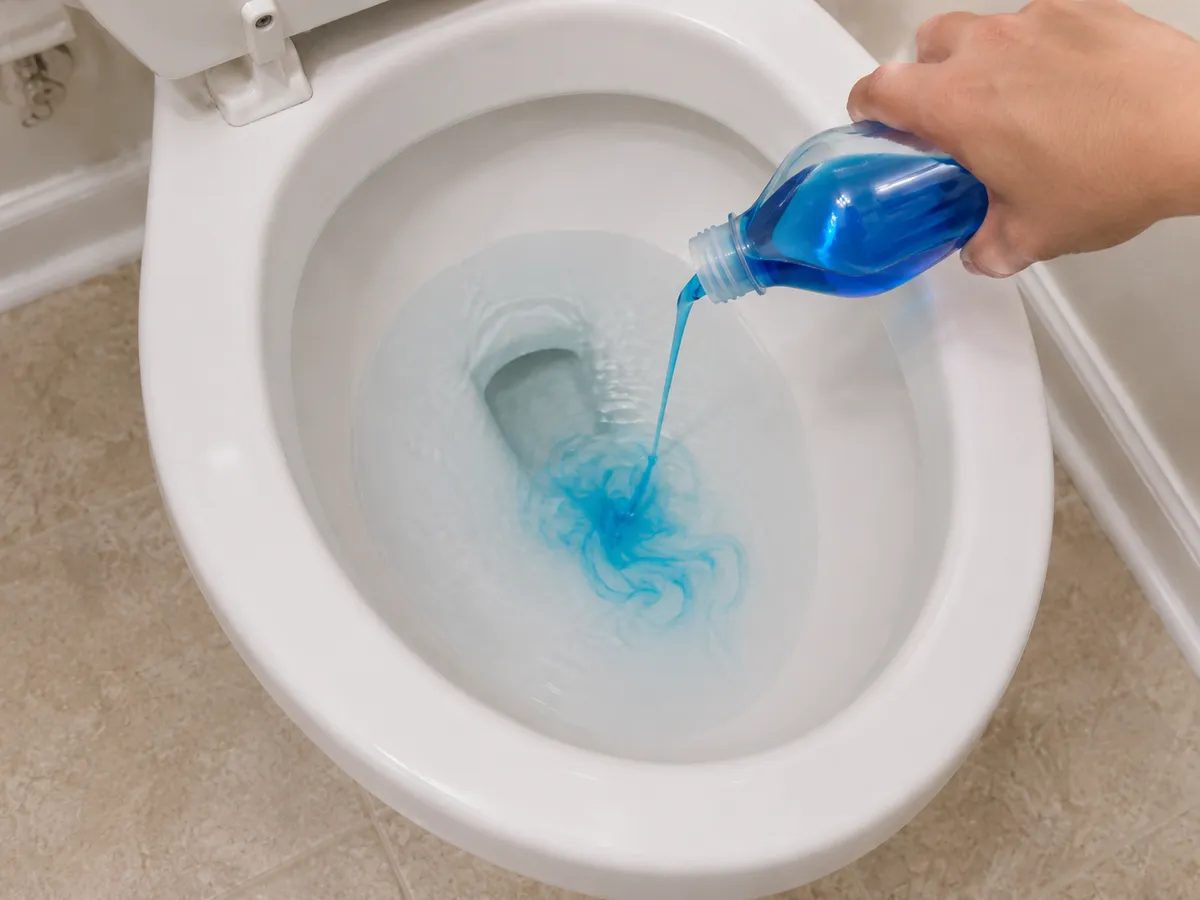
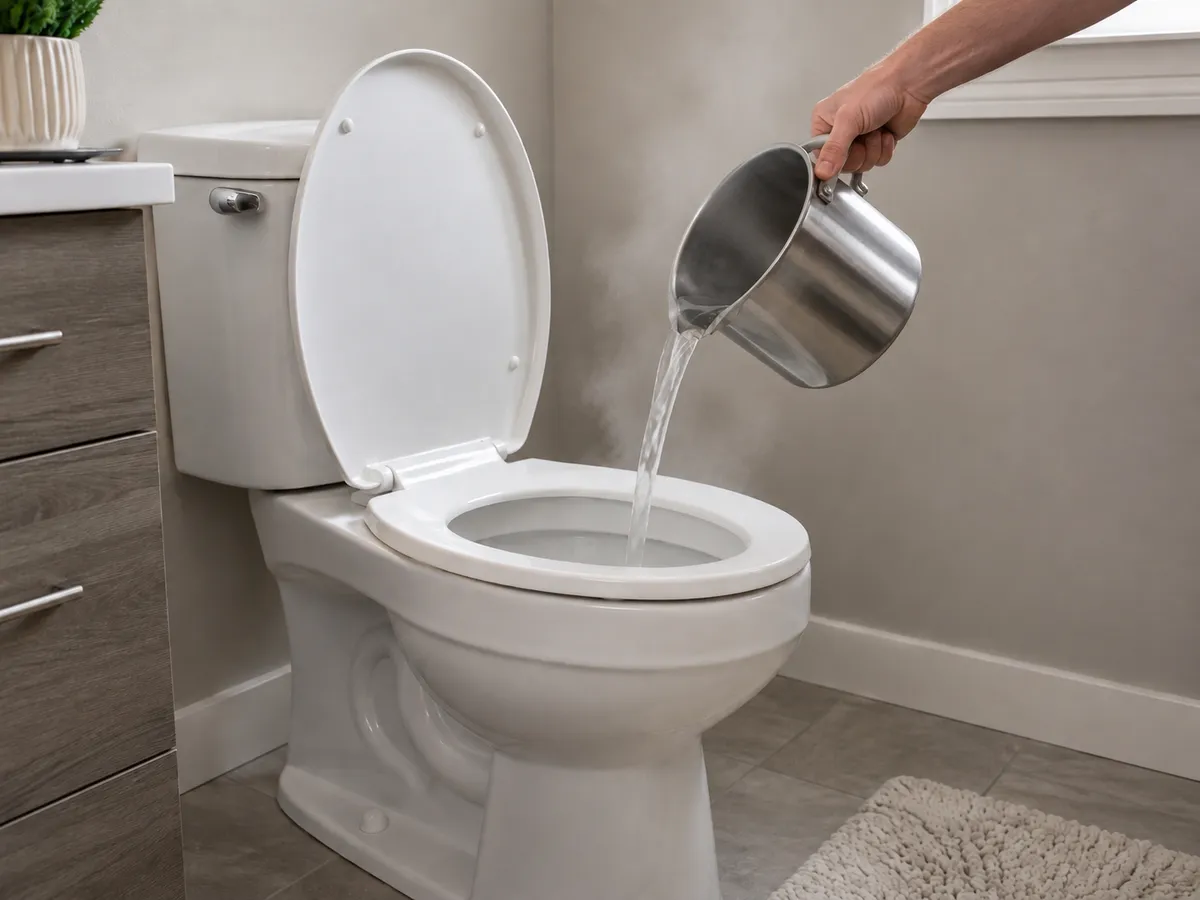
Pour about half a cup of liquid dish soap into the bowl. It is heavier than water, so it sinks and works its way into the blockage. Give it ten minutes. Then heat a gallon of water until it steams, and pour it into the bowl from about waist height.
Two things are happening. The soap lubricates the trap so the mass can slide through, and the falling water adds pressure the toilet’s own flush does not.
Use hot tap water or water heated just short of a boil. Never boiling. Boiling water hitting cold porcelain can crack the bowl, and a cracked bowl is a new toilet, not a repair. Wait twenty minutes before you try a flush.
Method 3: A bucket of water, poured from height
If you have no soap, the bucket alone is still worth doing, and it is the fastest thing on this page.
Fill a bucket with hot water, stand close, raise it, and pour steadily. The weight of the falling water is what displaces the blockage. Pour, do not dump, or you will splash the room.
Watch the bowl while you pour. If the level starts climbing instead of holding, stop immediately. Filling a clogged bowl to the brim leaves you with the same clog and nowhere to work.
Method 4: Baking soda and vinegar
This one is hands-off, which makes it the choice when you would rather not touch anything.
Pour in one cup of baking soda, then two cups of white vinegar, slowly, because it foams. Let it sit for at least half an hour. Follow it with a gallon of hot water and wait another ten minutes before flushing.
It works on organic clogs, which is most of them. It will do nothing at all to a wipe or a paper towel, and flushable wipes are not flushable no matter what the package says. Do not chase it with a bottled drain opener either, for the reasons in why store bought drain cleaners are a bad idea.
Method 5: The toilet brush you already own
A toilet brush is a bad plunger, but it is a plunger.
Put on gloves. Push the brush head straight into the drain opening at the bottom of the bowl, then pump it up and down quickly. You are trying to move water back and forth against the blockage rather than seal against it, so it takes more strokes than a real plunger would.
Expect splashing, and expect to throw the brush away afterward. It works on soft clogs sitting right at the opening and does nothing for a blockage further down.
Method 6: A wire hanger to reach the trap
This one sounds old-fashioned and works anyway, as long as the clog is inside the trap.
Straighten a wire coat hanger and wrap the working end in a rag secured with tape, so bare wire never touches the porcelain. Feed it into the drain opening and work it in small circles. Do not flush until you see the water level drop on its own.
The limit matters here. A hanger reaches the trap and no further. If a toy, a toothbrush, or a phone has gone past the trap, stop. Pushing it deeper is what turns a drain cleaning visit into pulling the toilet off the floor and resetting the wax ring. Keeping objects out in the first place is the whole point of the things you should never flush.
Method 7: Cut a plastic bottle into a makeshift plunger
This is the last thing to try before you call someone, and it is the messiest thing on the list.
Take a large empty plastic bottle, cut the bottom off, and leave the cap screwed on. Hold it by the neck, push the open end into the drain opening, and squeeze the body hard to drive a jet of water into the blockage.
Wear gloves and long sleeves. This one splashes back more than any other method here, which is exactly why it is seventh and not first.
Which method for which clog
| Method | What it clears | How long it takes | What can go wrong |
|---|---|---|---|
| Full flush | A weak flush that was never a clog | Seconds | A second flush overflows the bowl |
| Dish soap and hot water | Paper and organic waste, most household clogs | About 30 minutes | Boiling water cracks the porcelain |
| Bucket of hot water | Soft clogs, when you need speed | Under 5 minutes | Pouring into a full bowl overflows it |
| Baking soda and vinegar | Organic clogs, hands-off | 40 minutes or more | Does nothing to wipes or objects |
| Toilet brush | Soft clogs sitting at the opening | A few minutes | Splashing, and a brush you throw out |
| Wire hanger | Objects and packed paper inside the trap | 5 to 10 minutes | Bare wire scratches the bowl; pushing an object past the trap |
| Cut plastic bottle | Stubborn soft clogs when nothing else is left | A few minutes | Heavy splash-back onto you and the floor |
| Waiting overnight | Toilet paper, which breaks down on its own | 8 hours or more | Nothing, which is why it is worth doing |
When to stop and call
Two attempts is the honest limit. Past that you are not clearing anything, you are risking the fixture and the floor.
Call a plumber when the bowl drains slowly but never empties, when water rises into the tub or shower while you flush, when you can hear the drain gurgling somewhere else in the house, or when you know an object went down and you cannot feel it with a hanger. Water around the base of the toilet is its own emergency, because that is not the clog, that is a seal or a supply line.
That last one moves faster than people expect. This is a real job of ours from a Central Florida home where a toilet supply line burst at 12:30 in the morning and flooded the house. It is not an unclogging demonstration. It is what the water damage and the three days of drying looked like afterward, and it is the reason we tell people to find their shutoff valve before they need it.
Overflowing wastewater at midnight is what our 24 hour emergency plumbing team exists for. Call (863) 667-6364 and someone picks up.
When the clog is not the toilet: main line backups in Lakeland and Plant City
Flush the toilet and go look at the tub. That one test tells you whether you have a toilet problem or a house problem.
If water comes up in the tub or shower when you flush, the toilet is fine. The blockage is in the main line that every fixture in the house shares, past the point where the toilet ties in. Nothing you pour into the bowl reaches it. That is sewer backup repair, and it needs a drain machine and usually a camera. Water coming up from the shower drain walks through reading those symptoms.
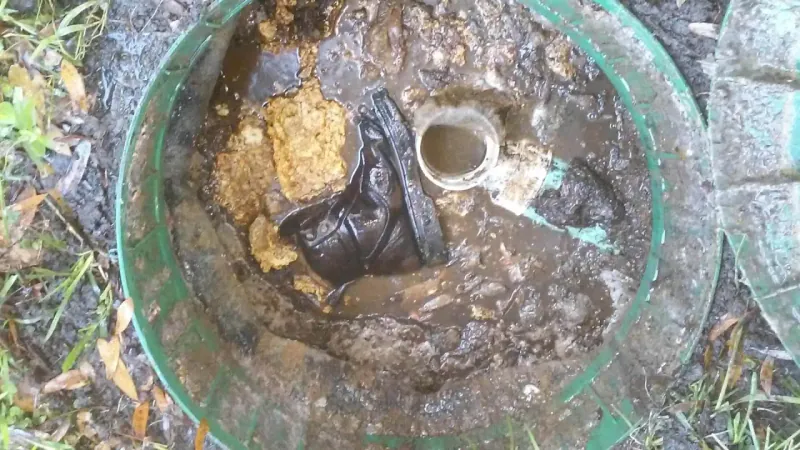
We see this constantly across Polk County, and there are local reasons for it. Older neighborhoods in Lakeland and Plant City still have clay or cast iron laterals, and mature oak and ficus roots find the joints in those pipes and grow into them. Central Florida’s sandy soil lets lines shift and settle over time, which opens the joints further. Plenty of homes out toward Bartow and Mulberry are on septic instead of sewer, and a full tank or a saturated drain field backs up at the lowest fixture in the house exactly the way a main line clog does. If your toilet backs up every few months no matter how carefully anyone flushes, the problem is in the line and not the bowl, and on a septic property drain field service may be the answer.
Where we work
We are based in Plant City and run trucks across Polk and Hillsborough counties every day. Lakeland is our busiest service area, followed by Plant City, Winter Haven, Zephyrhills, Davenport, Tampa, and the towns in between them.
If you are reading this from somewhere else in the country, the seven methods above are the same everywhere. The service area pages are for the Central Florida readers who need someone to actually show up.
Related plumbing services
A clogged toilet is usually a one-off. When it is not, it is pointing at something else:
- Toilet repair and replacement for a toilet that clogs weekly, runs constantly, or rocks on the floor.
- Drain cleaning for a line that has narrowed over the years and now catches everything.
- Sewer backup repair when more than one fixture backs up at the same time.
- Emergency plumbing for the overflow that is happening right now.
True Plumbers & AC has served Central Florida since 2009. Licensed plumbing CFC1428965 and HVAC CRC1335717. Call (863) 667-6364.

Entire House Flooded by a Toilet. A toilet supply line burst at 12:30 at night and flooded the whole house. True responded within the hour; this is the job, from extraction to day three drying.
Read the transcript ▼
now this is full water probably goes throughout so you know this literally happened about an hour hour and a half ago response time we're already here you're supposed to get to work [Music] [Music] [Applause] [Music] okay so here we are at the brown residence two nights ago I want to talk in the morning they had a pretty much count of stroke water damage due to water supply line in the toilet affected the whole house they came home around 12:30 notice water coming out of the garage treat others responded within an hour and did water extraction today we're at day three the house is almost dry but we're still in the middle of the process a lot of equipment is in the house a lot of furnitures been moved around and the floorings been removed so we still have some work to do take you for a walk inside to show you where we are [Music] so here's where the homeowner found the water coming out of his house from the garage the garage here when it down the drive went into the street this was ground zero was to the left yet all guitars and equipment on [Music] whole bunch of equipment in here we probably have about 35 fins inside the house right now in about four or five dehumidifiers trying it out once the equipment's done each job will remove the equipment usually on day three or four depending on the severity once the equipment gets removed we'll clean up the property try to get it into a workable condition but then the repo process will begin [Music]